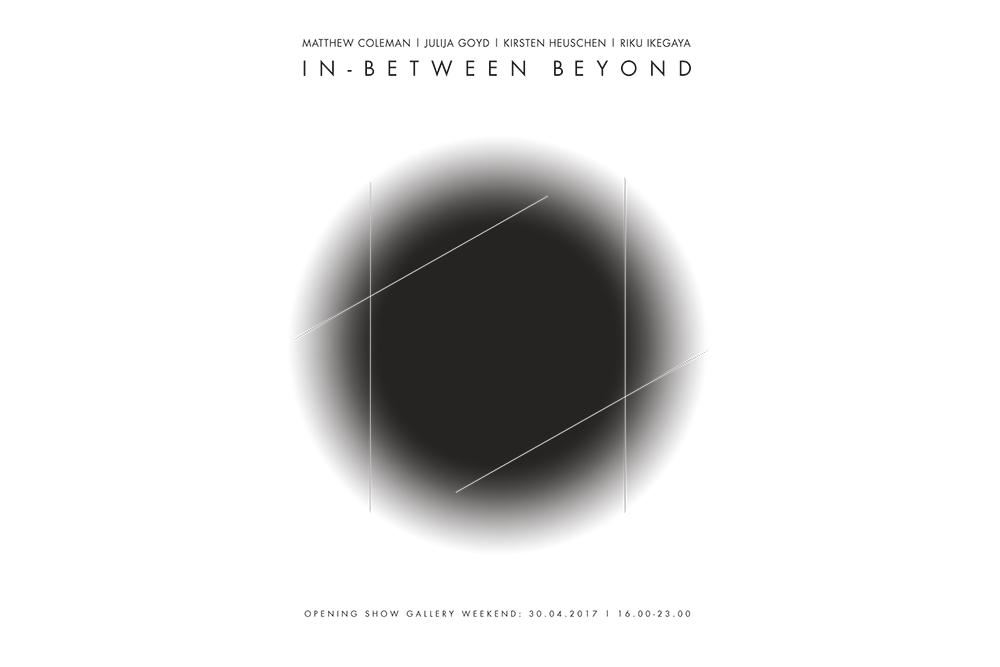
IN-BETWEEN BEYOND - Group exhibition with works by Matthew Coleman, Julija Goyd, Kirsten Heuschen, Riku Ikegaya The work of the Greek philosopher Heraclitus of Ephesus exists only in fragments and even his contemporaries considered his work unfinished, abstruse, and open to manifold interpretations. Nevertheless, his doctrines of "universal flux" (panta rhei) and the "unity of opposites" have influenced a diverse variety of thinkers, including Plato, Goethe, Hegel, and Schopenhauer. Panta rhei, translated literally from the ancient Greek, means "everything flows." Over time, the idea of universal flux has been condensed to the following aphorism, attributed to different thinkers at different times: change is the only constant. Heraclitus' doctrine of the unity of opposites describes the situation in which the existence or identity of an object or idea is dependent on the co-existence of at least two conditions which are opposite to each other. These conditions are however, dependent on each other and presuppose each other, within a field of tension. It follows, for Heraclitus,…